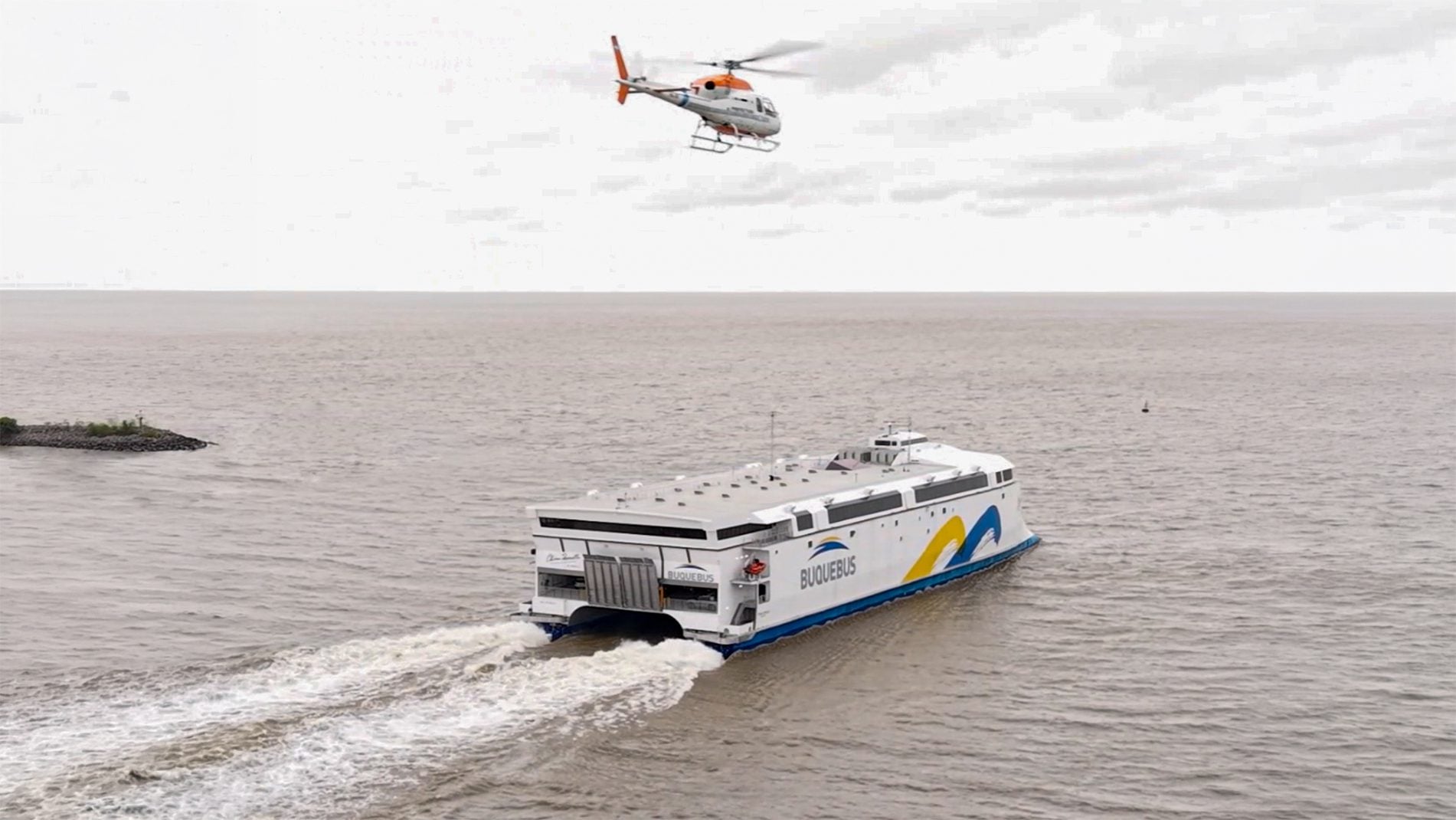
China Zorrilla, described by gCaptain as the world’s largest battery-electric ship, began commercial operations on October 22 with a crossing from Buenos Aires, Argentina, to Colonia, Uruguay. Australian shipbuilder Incat Tasmania built the 130-metre high-speed catamaran for ferry operator Buquebus. It can transport up to 2,100 passengers and 225 vehicles across the River Plate, relying entirely on batteries rather than conventional marine engines.
According to gCaptain, the vessel’s energy storage capacity exceeds 40 megawatt-hours, with more than 250 tonnes of batteries supplying eight electrically powered waterjets. Dedicated high-power charging facilities at terminals on each side of the river allow the ferry to recharge between sailings. Those shore installations support its regular operation on the fixed international route.
The propulsion arrangement represents a substantial change from the ship’s original design. China Zorrilla was initially intended to run on dual-fuel engines using diesel or liquefied natural gas, before the project was revised to adopt fully electric propulsion. The switch required significant engineering changes during construction, gCaptain reported. Its entry into passenger service brings that redesigned vessel into commercial operation.
An inauguration in Buenos Aires on October 21 preceded the first commercial crossing. Attendees included Incat managing director Craig Clifford, representatives of Buquebus, and maritime authorities and government officials from Argentina and Uruguay. Incat chairman Robert Clifford credited workers at the company’s Hobart yard with resolving the engineering challenges and said the vessel demonstrated the feasibility of electric propulsion for large, high-capacity commercial ships.
The report says the ferry produces no direct exhaust emissions during crossings and has less machinery noise and vibration than vessels with conventional diesel engines. Craig Clifford, who travelled on the first commercial sailing, also highlighted the quieter onboard experience. Passenger facilities include roughly 2,300 square metres of duty-free shopping space.
The delivery forms part of Incat’s wider electric-vessel construction programme. gCaptain reported that the Hobart shipbuilder is also building three 129-metre battery-electric ferries for Danish operator Molslinjen, alongside two 78-metre hybrid-electric vessels.